
Medina Projected Versus Actual Release
TDCJ uses several date labels. A projected release date is calculated by Classification and Records and estimates when a state prisoner may leave incarceration if parole does not occur first. The maximum sentence date marks sentence expiration, but it may not be the day of physical release. A scheduled release date and location appear later, after release-plan review and a certificate audit. The actual release date records when custody changed.
County custody is different. A Medina County Jail detainee awaiting trial has no computed sentence-release date. Bond, a court order, dismissal, transfer, or later judgment determines what happens. A person serving a county sentence may have a local release calculation that includes jail credit and any lawful commutation. Do not put a TDCJ date formula onto a county stay.
- Projected date
- A forward-looking TDCJ calculation that can be revised.
- Scheduled date
- A later operational date posted after release processing advances.
- Maximum sentence date
- The legal endpoint shown by TDCJ, not always physical release day.
- Actual release
- The recorded custody event when the person leaves or transfers.
Find a Medina Projected Release Date
Identify the holding agency before searching. Ruben M. Torres Unit and Joe Ney Unit are TDCJ prisons in Medina County, so their sentence dates come from TDCJ. The Medina County Sheriff does not calculate those dates. By contrast, a person whose whole sentence remains at Medina County Jail must be checked with the jail record and sentencing court.
- For a current state prisoner, open the TDCJ offender search. Search first by seven-digit TDCJ number or SID number, then use name and supported details if those identifiers are unknown.
- Match the offense, county, age information, sentence, and location. Exact last-name matching and working-day data that may be at least a day old can affect the result.
- Copy each label exactly: projected release date, maximum sentence date, parole review fields, and any scheduled release date or location. Never merge them into one date.
- If no current TDCJ result appears, email pia@tdcj.texas.gov for incarceration history with the full name and TDCJ number. If the number is unknown, provide exact birth date, or age and county of conviction.
- For a Medina jail sentence, call 830-741-6058 and obtain the booking/release record. Read the judgment for sentence length, jail credit, and later court corrections.
- Recheck near release. A court order, hold, discipline event, Board action, or release-plan issue can change the expected date.
The Medina County released-inmate lookup adds the durable Sheriff record and court disposition when a date search becomes a past-release check. A negative live-roster result alone does not show release.
The official TDCJ definitions page is the source for the agency's projected-release terminology.
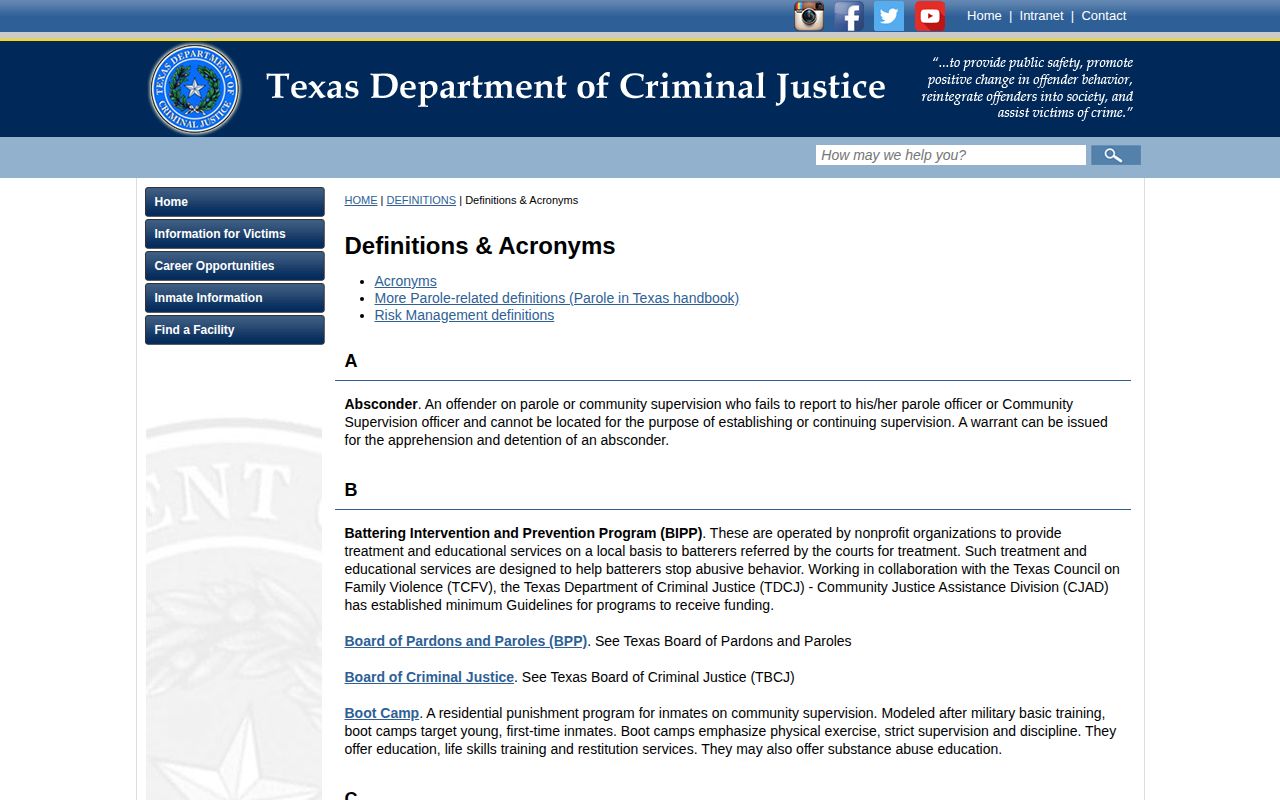
The captured agency page helps keep the projected, maximum, and scheduled labels distinct during a Medina release-date lookup.
Texas Good Time for Medina Releases
Texas Government Code Chapter 498 governs TDCJ good conduct time. It is a classification and release-calculation tool, not a simple reduction anyone can apply to a sentence. Good time generally does not cut the sentence imposed by the court. Instead, eligibility rules, offense date, offense type, calendar time, credit class, mandatory-supervision law, and Board action determine how it affects a projected date.
For an eligible offense before September 1, 1996, TDCJ defines the projected point as flat time plus good time reaching the sentence. For a later eligible offense, discretionary mandatory-supervision review may also be required. A denial can move the projected date toward maximum expiration. For an offense that is not eligible for mandatory supervision, the projected field may match maximum expiration unless parole occurs sooner. Government Code Chapters 498 and 508 must be read with the controlling offense date.
Broad claims that every Texas prisoner serves a fixed percentage are not reliable. Government Code Sections 508.145 and 508.149 contain different eligibility and exclusion rules, and older “3g” language now largely maps to Code of Criminal Procedure Article 42A.054. Use the TDCJ calculation and the judgment rather than a web calculator.
Why Medina Release Dates Move
Projected dates are built from a live legal and custody file. When one part changes, Classification and Records may recalculate. A date also may stay the same while the release location or plan changes. The field should be treated as a current estimate, not a promise to family or the person in custody.
| Factor | Possible effect | Best source |
|---|---|---|
| Discipline or good-time loss | Moves the projected point or changes eligibility | TDCJ classification record |
| New sentence or corrected judgment | Changes sentence structure or credit | Sentencing court and TDCJ |
| Detainer or agency hold | May cause transfer instead of community release | Holding and receiving agencies |
| Parole vote | Can authorize earlier conditional release or set another review | Board status and vote code |
| Release plan or program | Can delay certificate processing or set conditions | TDCJ Review and Release Processing |
| Mandatory-supervision decision | Can approve release or recalculate toward discharge | Board and TDCJ offender record |
A favorable parole vote still does not prove physical release. TDCJ audits the proposed residence, county, program needs, special conditions, and other plan facts before it issues a release certificate. After a favorable vote, Parole Division release status is available at 512-406-5202.
Confirm a Medina County Release
Use the record made by the agency that held the person. For Medina County Jail, ask whether the person is still there, was released, or transferred, then request the release entry for a durable date and type. Check the criminal case for the bond order, judgment, sentence credit, dismissal, or discharge that explains the movement. For a TDCJ case, recheck the offender detail and use the relevant information line.
Texas now uses IVSS-Counties for covered county events and a separate TDCJ IVSS for prison and parole events. An alert can provide speed, but the service says its information is not an official record. A transfer-to-TDCJ alert is not community release. The Medina VINE inmate check explains the current IVSS route and the end of legacy VINELink instructions.
Medina Jail Date Calculation
Code of Criminal Procedure Article 42.032 allows a county sheriff to award commutation for good conduct, industry, and obedience in a county jail sentence, subject to the statute. This local authority is separate from TDCJ good conduct time. A Medina jail calculation therefore depends on the sentence, credited days, the Sheriff’s application of lawful commutation, and any later court order.
No official Medina source publishes a public release calculator or a fixed weekend-release rule. Ask the Jail for the current calculation and ask the sentencing clerk for the judgment. The jail is continuously open, but that does not prove records staff work all hours or that releases happen on a set schedule.
Medina TDCJ Date Labels
TDCJ’s distinction between projected and scheduled dates is especially important in Medina County because two state prisons sit near Hondo. The physical site does not make either unit a county jail. Torres and Ney records remain statewide TDCJ records, and an internal move from either unit is not a community release.
Once a certificate audit is complete, scheduled date and location offer more operational detail than the projected field. They are still subject to change. Record the retrieval date, verify the TDCJ number, and call close to the event. This sequence avoids the local error of taking a Torres or Ney transfer as proof that a person went home.
Medina Parole Timing Checks
Parole eligibility, Board review, approval, release processing, and physical release occur at different stages. TDCJ offender details may show review information while a person remains incarcerated. The Board status line at 844-512-0461 answers review questions. After a favorable vote, the Parole Division release-status line answers later processing questions. Neither call should be replaced with a guess based on an expected month.
Board vote codes also carry different meanings. Some authorize release when eligible. Others specify a month, require treatment or a program, direct a transfer, deny release with a later review, or require the person to serve all. Approval can be withdrawn. Read the exact vote, confirm that its condition was met, and wait for the scheduled field or agency confirmation before planning around a day.
If release is to parole or mandatory supervision, the sentence has not necessarily ended. TDCJ Parole Division supervises that phase. A discharge or maximum expiration is a separate event. The distinction explains why someone may be outside Torres or Ney yet still have an active TDCJ status.